


On the Restoration and Promotion of the Traditional Mass
On the Restoration and Promotion of the Traditional Mass

The third anniversary of the election of Pope Francis seems an apt time to take stock of the state of the Traditionalist movement within the Church. While the term may encompass various goals for the Church, I focus here on its essential aim, namely the restoration and promotion of the Tridentine liturgy.
The reign of Benedict XVI was seen as a springtime for Traditionalism. Benedict had an evident affinity for a traditional-style celebration of the Mass. His solicitude for the traditional Mass was concretely expressed by his promulgation in July 2007 of the motu proprio Summorum Pontificum (SP). With SP as the foundation, many Traditionalists were confident that Benedict would re-introduce traditional practices on a broader scale as his pontificate progressed, and perhaps even revise the Missal of Paul VI.
Alas, it was not to be. With Benedict’s resignation and the election of Francis, the papacy’s gaze has turned from things liturgical to a myriad of other matters. Pope Francis has said, written, and done much in his short reign; but, as far as I know, he has never directly addressed the state of liturgical affairs. To the great dismay and frustration of Traditionalists, who rightly see the Mass as the heart of the Body of Christ, Francis appears indifferent to the most pressing need of the Church—liturgical renewal.
Francis has, however, let stand SP. Yet as great a gift as SP is for the Church, it is far from the total or final solution to the problems that have given rise to the Traditionalist movement in the first place. On the contrary, in the words of Churchill, SP marks only the “end of the beginning.”
SP is often described as “freeing” the traditional Mass. This description is not entirely accurate. It is true that SP allows any priest to use the 1962 Missal without the need for special permission, but this prerogative only applies to “Masses celebrated without the people”—that is, a priest’s private Mass (SP Art. 2). SP contains a separate provision for public Masses, and it does not provide an unfettered right for the celebration of such Masses. Rather, SP directs pastors to “willingly accept” the requests of “a stable group of Faithful” in a parish that wishes to have the Traditional Mass offered in that parish (SP Art. 5, Sec. I).
This legal distinction is of critical importance to the future efforts of the Traditionalist movement as it seeks to employ SP as the principal tool for re-birth of the traditional Mass. For, in order for the Traditionalist movement to realize its aims, the “Extraordinary Form” of SP must become less out-of-the-ordinary. While it is true (and wonderful) that the number of places in which the Tridentine Mass is regularly offered has grown markedly since the promulgation of SP, it is a fact that the vast majority of parishes provide Mass-going Catholics with no access or exposure to the ancient rite. The Extraordinary Form remains relegated to specific churches at limited times or to usage on special occasions.
Nonetheless, under the framework of SP, the impetus for the spread of the traditional Mass belongs to the laity. Benedict, perhaps, chose this approach to give the traditional Mass the mark of popular piety so that its return would be seen as resulting from the desire of the Faithful, not the imposition of dreaded “experts.” In theory, this is wise, but relying primarily upon the laity presents definite practical impediments.
The most obvious problem is lack of familiarity among the laity with the ancient rite. Thanks to the speed and ferocity with which the Church suppressed the Tridentine liturgy after Vatican II (beginning with the “interim” Missal of 1965), no one under 50 years of age has experienced the traditional Mass as the common Lex orandi.
Those older have mostly forgotten it. They have long accepted the practices that typically accompanied the implementation of the Novus Ordo—elimination of Latin entirely, versus populum worship, Communion in the hand while standing, copious use of “Eucharistic Ministers”—and on and on. In many parishes these practices are as fixed as once was the Canon, and changes to them are even regarded as disruptive to “tradition,” roughly defined as that which has been handed down from Cardinal Bernardin and his successors since ancient times, circa 1975.
Thus, SP has created a church within the Church, where the small but fervent band attached the traditional Mass adheres to a different calendar, often hears different readings than those proclaimed at the Novus Ordo and, in general, experiences significantly different liturgical norms and practices.
This “church within a Church” situation is not optimal. It can lead to a kind of separatism among those attached to the old rite who, perhaps unintentionally, come to look down upon the masses at the Novus Ordo parishes where parishioners are subjected to ugly vestments and “Here I am Lord.” Traditionalists can become cut off from the life of their local parishes, too, because they often must travel to specially designated churches on Sundays in order to hear the Tridentine liturgy.
This situation is not in keeping with Benedict’s hopes for SP, in which he stresses that the two “forms” of the Roman Rite must co-exist as equally valid expressions of the Lex orandi that “will in no way lead to a division in the Church’s Lex credendi” (SP Art. 1). But, in practice, this is not so. The Traditionalists are outside the common experience of modern Catholic life, and the average Mass-going Catholic hasn’t a clue about the traditional Mass or the radical departure from the age-old worship of the Church occasioned by the Novus Ordo and the way it is typically celebrated in many parishes. The divide is rarely noticed, but it is serious, for it is contrary to the very nature of the Church, the first mark of which is its “oneness”—Ecclesia una est.

I love the sacredness and holiness of the Mass and all of our beautiful rituals!
most Catholics are Roman Rite and we are one of those, we are here to restore the sacredness of the Roman Rite to the Holy Latin Mass and all the other Holy Latin Sacraments.
 Ste. Chapelle France
We are so blessed to rediscovering the great sacredness and beauty of the Holy Roman-Latin Rites of the Catholic Church and to be doing something to restore them back to their grandeur and holiness.
 I love the sacredness and holiness of the Mass and all of our beautiful rituals! The Sacrifice of the Mass, it might be said, is the ultimate ritual. Rituals inform Catholics of the divine; and are an acknowledgement that something spectacular and extraordinary is taking place.
The Mass is not about us, but about Him. You'll notice that it is the altar that is up front and center, not the pulpit, or a personality. We go to Mass to worship God, not to be entertained. Mass is not something that needs to be re-branded, re-invented, thrown out all together, or a part of new and improved marketing campaign that talks of charity (love) without also speaking of God's Truth. Mass isn't where you go to hear just what you want to hear, but instead you will hear what you need to hear. Of course you hear of God's love and God's mercy, but also of His justice. We put our love into action by clothing the naked, serving the poor,and feeding the hungry.We love and serve others, but we do not throw out loving and worshiping God.
The Mass is the most important and sacred act of worship in the Catholic Church. It incorporates Sacred Scripture, prayer, sacrifice, hymns, symbols, gestures, sacred food for the soul, and directions on how to live a Catholic life — all in one ceremony. Through time and space, we connect with the original Last Supper.The Mass is the "re-presentation" of the sacrifice of Calvary. This is misunderstood by many who claim that the Mass is a re-crucifixion of Christ. It is not.
Jesus says that the greatest Commandments are to love God with your whole strength and your whole soul, and to love your neighbor as yourself. Love God first, and then by loving and imitating Him, you will love one another more. Does He know if you love Him? Of course, because He's God - He knows everything. But He never said to not care about what He thinks of you. He wants all of us to strive for holiness. He wants us to obey the 10 Commandments. He wants us to love Him because He knows we need Him. We need to love and draw closer to God to grow in holiness, which in return will help us to love others more.
I love how Catholics genuflect and kneel at Mass. We kneel because we are in the presence of God. Kneeling is a very meaningful and intimate gesture, and it expresses adoration and shows our reverence towards Him. We live in a society today that in many ways has lost reverence for things which are holy and sacred. We approach God in a way that is casual, almost as if He is on the same level as us. This lack of reverence can reflect a lack of humility, and think that things are all about us. When we kneel we remind ourselves that we are not God and we are not in charge; rather, we are only creatures before our Lord.
Kneeling in God’s presence during Mass emphasizes the Real Presence of Christ in the Eucharist, and how much we love and adore our King. St. Paul says, “that at the name of Jesus every knee should bow, in heaven and on earth and under the earth” (Philippians 2:10). Like St. Paul, we get down on our knees during Mass and humbly adore Him. Of course, rituals are meaningless if they are not an expression of love for Christ. Love is the very thing that gives them reason for existing in the first place. The root of all Catholic ritual is the authentic love of Christ.
I love how we have crucifixes. Does this mean we worship a "dead" Jesus, and that we shouldn't leave Him on the cross? Absolutely not. Some have expressed distaste at the thought of depicting Jesus at his most vulnerable. Guess what? This should make you uncomfortable. Jesus does not want us to look at His Crucifixion as only a past event. Every lash that he took, every blow that drove the nail into his hands was caused by you and me. Our sins – past, present and future, hung Jesus on that cross. The sins you are committing right now are another lash and another nail in His body. The crucifix is the ultimate expression of the lengths that a loving God will go to reach us. Gazing at a crucifix is a truly humbling experience.
Christianity is not a religion designed to make you feel good all the time. Our religion is rich, joyful and sacred, but also more demanding than that. Sacredness, holiness, rituals, and sacred scripture, are not irrelevant like many are wanting you to believe today. They are all important, and draw us closer to our almighty God. Of course Jesus wants us to love one another, but love God first, and remember, we are not God. Jesus says we cannot be His follower (a Christian) unless we pick up our cross to follow Him. (Matthew 16.24) Jesus never promised His followers a Christian life free from sufferings and trials. He promised us the very opposite. He promised that we too would have a cross to carry; and unless we endure our sufferings and trials in faith for Him as He has done for us, we cannot be His follower.
Do not throw out the sacred. And do not ever believe anyone who tells you that the Mass, sacredness, rituals, holy scripture, the 10 Commandments, and caring about what God thinks of you are "irrelevant." God is the center of the Catholic Mass - it is all about God and striving for holiness by imitating Christ, which in return will show us how to love others more. We all need more sacredness, holiness and more humility in our lives to remind us who God is, and who we are before our God
Restoring Beauty in the Sacred Liturgy

Next to the elevation, seen above, this below is one of the most beautiful scenes in the usus antiquior. The deacon and subdeacon are showing reverence for the sacredness of the moment when the celebrant consumes the Body of Christ and the Precious Blood. This visible sign of reverence should draw us into deeper prayer, if we are not yet there.

Restoring Beauty in the Sacred Liturgy
Fr. Scott A. Haynes
From the Nov/Dec 2007 Issue of Lay Witness Magazine
From the Nov/Dec 2007 Issue of Lay Witness Magazine
Jesus Christ has chosen the Church for His Bride. In nuptial love, the Bride of Christ looks into the eyes of the Bridegroom and calls out: “Splendor and majesty are in his presence; power and beauty are in his sanctuary” (Ps. 96:6).
The wedding feast of the Lamb described in the Book of Revelation actually describes the sacred liturgy of the Church [1]. In the climax of her heavenly worship, the Bride reflects the image of the Bridegroom-the image of the Word made flesh, who is Beauty Incarnate.
For the world, the maxim “beauty is in the eye of the beholder” [2] is a subjective statement. For the Bride of Christ, this is a concrete reality of the Incarnation.
Sadly, in our own times the banal and vulgar have invaded our sanctuaries, following what John Paul II called in Ecclesia de Eucharistia “a misguided sense of creativity” (no. 52). Nothing, therefore, is more important today than the restoration of the beauty of the sacred liturgy, the restoration of the sacred.
Hans Urs von Balthasar, the twentieth century’s most notable writer on the theology of beauty, said in his preface to The Glory of the Lord, “We can be sure that whoever sneers at Beauty’s name . . . can no longer pray and soon will no longer be able to love.”
In order celebrate the sacred liturgy with due reverence and beauty, the Church must be able to “distinguish between the sacred and the profane” (cf. Ezek. 44:23). When false types of “inculturation” pollute liturgical worship, we must be mindful that “all is not valid; all is not licit; all is not good” [3]. The secular, the cheap, the inferior, and the inartistic “are not meant to cross the threshold of God’s temple” [4].
The Canons Regular of St. John Cantius is a religious community that began in 1998 and serves the Archdiocese of Chi- cago. The order, comprised of 25 priests and brothers, strives to “restore the sacred” in the context of parochial ministry. Their mission requires, first and foremost, contemplation of the beauty of Christ in the sacred liturgy-what Sacrosanctum Concilium calls “a sacred action surpassing all others” (no. 7). This begins with external fidelity to the rubrics, but leads to internal union with Christ, for “those who worship him must worship in spirit and truth” (Jn. 4:24).
The spiritual beauty of the sacred liturgy transforms the lives of Catholics. Indeed, as then-Cardinal Joseph Ratzinger said in an August 2002 message to Communion and Liberation, “The encounter with the beautiful can become the wound of the arrow that strikes the heart and in this way opens our eyes.” This spiritual beauty forms the Christlike heart in moral beauty. And when the spiritual beauty of the sacred liturgy has transformed a soul, man can then create things of beauty, such as art, architecture, poetry, and music.
This man-made beauty, formed by the beauty of Christ in the sacred liturgy, imitates the creative genius of God who gave this world an inherent natural beauty. When the beautiful and radiant face of Christ our Savior becomes the center of sacred worship, all creation longs to cry out with the psalmist: “Every work that He does is full of splendor and beauty” (see Ps. 111:3).
If the beauty of Holy Mass does not, in essence, rely upon the splendid beauty of things such as iconography, ornate vestments, Gregorian chant, or baroque architecture, why then has the Church invested so much of its patrimony in fostering these sacred arts? God has placed a legitimate desire in the human soul to create beautiful things because He wants man to share in His masterpiece of creation, a creation that is good and beautiful. The Canons Regular, in their apostolate, hope to foster this excellence, and seek to beautify the celebration of the sacred liturgy by the enhancement of the sacred arts.
Beauty in the liturgy results from order. This is why the liturgy, by its very nature, demands order. The liturgy cannot exist without rubrics or ceremony. Beauty shines through the gestures of the sacred liturgy. Thus, external acts of worship such as making the Sign of the Cross, genuflecting, kneeling, and bowing become ways to internalize reverence and beauty in our human lives.
“Every liturgical gesture, being a gesture of Christ, is called to express beauty,” wrote Archbishop Piero Marini, the master of papal liturgical celebrations, in his 2006 book Liturgy and Beauty. And so the transcendent beauty of the liturgy permeates the hearts of men and forms us to have proper relationships, not only with God, but also with our neighbor, and therefore empowers us to transform human culture. This is the genuine meaning of “inculturation.” If we Catholics want the inherent beauty of the liturgy to convert the “culture of death,” we must permit the sacred liturgy to form us by its spirit and by its rubrics. This means that, in humility, we must renounce any desire to make the liturgy conform to changing whims. Consequently, let us renounce unauthorized innovations, rubrical improvisation, banality, and over-creativity.
John Paul II saw the restoration of the ancient Roman Rite, the anchor of Catholic identity and faith, as integral to the success of the “new evangelization.” He established the Ecclesia Dei Commission to facilitate this initiative. On July 7, Pope Benedict XVI promulgated a motu proprio, Summorum Pontificum, to intensify the work of the “new evangelization.” Now the complete restoration of the ancient Roman Rite, with all of its splendor and beauty, is possible. Pope Benedict achieved this in a genuine spirit of ecclesial unity and in full conformity with Vatican II. In a recent interview with the Italian daily Il Giornale, Russian Orthodox Patricarch Alexy II praised the Pope’s motu proprio, saying, “The recovery of the ancient liturgical tradition is a fact that we greet positively.”
Following the guidance of Pope Benedict, a new movement has recently arisen among the clergy and laity alike to restore the beauty of the ancient liturgy. Some priests are now preparing to celebrate this most beautiful, ancient, and laudable form of the Roman Rite. In order to encourage priests to celebrate the ancient form of the Roman rite, the Canons Regular have launched a new website, www.SanctaMissa.org, as an online resource and tutorial on the celebration of the Mass according to the 1962 Missale Romanum. It provides the rubrics and texts of the Mass, as well as audio and video materials.
Additionally, the Canons Regular now teach priests to offer the Mass according to this form both here in the United States and abroad. In August 2007, at the invitation of Bishop Eugenijus Bartulis of the Diocese of Šiauliai, Lithuania, the Canons Regular traveled to Lithuania to teach priests and seminarians the extraordinary form of the Roman Rite and introduce them to its rubrics, history, spirituality, and beauty.
Celebrating the Roman Rite according to the ordinary form (Missale Romanum 2003) and extraordinary form (Missale Romanum 1962), the Canons Regular firmly hold that “the Old Rite becomes a living treasure of the Church and also should provide a standard of worship, of mystery, and of catechesis toward which the celebrations of the Novus Ordo must move. In other words, the Tridentine Mass is the missing link. And unless it be
re-discovered in all its faithful truth and beauty, the Novus Ordo will not respond to the organic growth and change that has characterized the liturgy from its beginning” [5].
re-discovered in all its faithful truth and beauty, the Novus Ordo will not respond to the organic growth and change that has characterized the liturgy from its beginning” [5].
[1] Rev. 1:10-13; 4:4-8; 5:14; 11:16; 14:3; 19:4.
[2] Anon. Greece, third century BC
[3] Address of Pope Paul VI to the Italian Society of St. Cecilia, Rome, April 15, 1971, Sacred Music,Vol. 98, No. 2 (Summer 1971), pp. 3-5.
[4] Ibid.
[5] Rev. Michael John Zielinski O.S.B. Oliv., Vice-President of the Pontifical Commission for the Cultural Patrimony of the Church and of the Pontifical Commission for Sacred Archaeology, “Interview with the Abbot,” available online at www.pecosmonastery.org/AbbotArchives7.htm <http://www.pecosmonastery.org/AbbotArchives7.htm>.
Fr. Scott A. Haynes, S.J.C., is a member of the Canons Regular of St. John Cantius. For more information about this order and its ministries, visit www.cantius.org, www.societycantius.org, orwww.sanctamissa.org <http://www.sanctamissa.org>.
Visit www.cuf.org/latinmassresources.html for a helpful list of resources for the celebration of the ancient form of the Roman Rite.
Associated PDF File:
This article is available as a PDF download
This article is available as a PDF download
Cardinal Sarah: "Rediscover the Sacrality in the Holy Mass"
Cardinal Sarah: "Rediscover the Sacrality in the Holy Mass"

Paix liturgique had welcomed the appointment of Cardinal from Guinea to succeed Cardinal Canizares in the fall of 2014. Now the information service writes:
Cardinal Chose Birituelle Paris Parish to Talk About the Liturgy
"In early March 2015 Cardinal Robert Sarah, Prefect of the Roman Congregation for Divine Worship and the Discipline of the Sacraments remained for a long time in Paris and the surrounding area in order to consult on the resultant interview book, "God or Nothing" with the journalist Nicolas Dat" (Fayard). The book paints a personal and surprising portrait of one of the most discreet and yet most important prelates of this pontificate.
While there are a large number of events attended to by the book, the Cardinal wanted to devote a considerable part of his time not the media, but the faithful. He visited several parishes. In each he took on a specific topic of his book. This included the liturgy, precisely about which he spoke in the parish of Saint-Eugène-Sainte Cécile, in which both Rites have been celebrated for 30 years," says Paix liturgique. The following is an excerpt of the liturgy part of Cardinal Sarah's book.
Joy and Gratitude for Summorum Pontificum
"Personally, I have received Summorum Pontificum with great confidence, joy and gratitude. It is the sign and proof of how the Church, mother and teacher, look at all the faithful, by taking into account all the sensitivities. Benedict XVI. wanted to support the wealth of different spiritual expressions in the belief that they will lead to the Church to true unity and an ever brighter scope for the holiness of the Church.
I think that this beautiful motu proprio fits perfectly within the bounds of the Council Fathers furrow. Therefore, we can not pretend we have forgotten what was declared expressly in Sacrosanctum Concilium: "For the liturgy contains as a divine institution immutable parts and parts which are subject to change. These parts may change over time, or even if something should have crept into it, that it doesn't affect the inner nature of the liturgy less than if they have been found to be less suitable or equivalent."
In the letter Summorum Pontificum accompanied Benedict XVI wrote .:
For that matter, the two Forms of the usage of the Roman Rite can be mutually enriching: new Saints and some of the new Prefaces can and should be inserted in the old Missal. The "Ecclesia Dei" Commission, in contact with various bodies devoted to the usus antiquior, will study the practical possibilities in this regard. The celebration of the Mass according to the Missal of Paul VI will be able to demonstrate, more powerfully than has been the case hitherto, the sacrality which attracts many people to the former usage. The most sure guarantee that the Missal of Paul VI can unite parish communities and be loved by them consists in its being celebrated with great reverence in harmony with the liturgical directives. This will bring out the spiritual richness and the theological depth of this Missal.
It is likely that we can better understand the celebration of the Mass according to the Missal of the old Mass as an act of Christ and not of men. Thus the mysterious and mystagogical character is also perceptible. Even if we actively participate in the Mass, it is not about our action, but those of Christ. In his Apostolic Letter Quintus Annus Vicesimus. John Paul II asks wherein lies active participation.
But what is this active participation? What must you do? Unfortunately, the word was very quickly misunderstood to mean something external, entailing a need for general activity, as if as many people as possible, as often as possible, should be visibly engaged in action. However, the world "part-icipation" refers to principal action in which everyone has a "part". And so if we want to discover the kind of doing that active participation involves, we need, first of all, to determine what this central actio is in which all the members of the community are supposed to participate. The study of the liturgical sources provides an answer that at first may surprise us, though, in the light of the biblical foundations considered in the first part, it is quite self-evident. By the actio nd the need for a general acting out derived therefrom, as if as many as possible as often as possible must be visible to all go into action. But the word "participation" (or "participation '' refers to a main plot, in which all are part-have. So if you want to find out about which actions to do it, then you have to determine first of all, that because these actual central "actio" is, to which would also involve all members of the community [...] Under the actio of the liturgy refers its sources, the Eucharistic Prayer. [...] The real liturgical action, the true liturgical act, is the oratio -.. the great prayer, which forms the core of the Eucharist which was therefore described by the Fathers as oratio ... .This oratio- the Eucharistic Prayer, the "canon" - is really more than speech is actio in the highest sense, because it happens that human actio (as they had hitherto been practiced by the priests in the various religions) withdraws and gives room for the actio divina, the action of God (Joseph Cardinal Ratzinger. The Spirit of the Liturgy, Herder, 6.Aufl, Freiburg im Breisgau 2002, S. 147f).
The Motu Proprio Summorum Pontificum tries to reconcile the two forms of the Roman Rite and tries above all to help us to rediscover the sacredness of the Holy Mass as an act of God and not of man. Here we touch upon a really important point. The problem of widespread indiscipline, lack of respect and loyalty to the Rite, may even attack the validity of the sacrament."
Excerpt from Robert Cardinal Sarah: Dieu ou rien, Fayard, Paris 2015, pp 400-402


MASS APPEAL: HOW THE TRADITIONAL MASS ENGAGES ALL FIVE SENSES
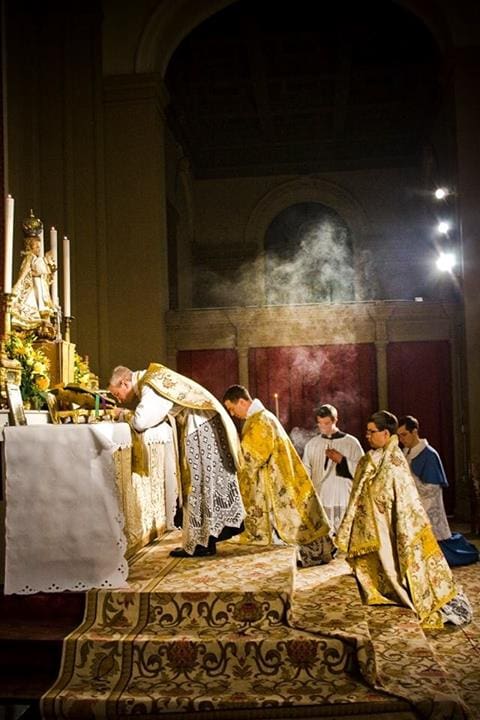 Back in the nineteenth century Father Frederick Faber famously wrote that the Mass was the “most beautiful thing this side of heaven.” As every Mass is a re-presentation of Calvary, and the altar itself the place where heaven and earth meet, one can understand why Saint Peter Julian Eymard called the Holy Sacrifice the “holiest act of religion.” Understanding all of this to be true, is it any wonder that more of the faithful are seeking a liturgy which seeks to restore a sense of the sacred?
For many, the Traditional Latin Mass is fulfilling just such a need. Rediscovering the manner in which the Church has worshipped for centuries has helped a growing number of Catholics to encounter the Lord more deeply. What many are realizing is just how effectively, and beautifully, the traditional Masses engage our senses. Indeed, it is a Mass for all senses.
SIGHT
The Latin Mass presents a visual which immediately speaks to the true focus of our adoration and worship. As the priest offers the Mass ad orientem (facing the altar or the liturgical east) we immediately recognize that the liturgy is not about us. This is something that simply must be experienced by the faithful to fully appreciate. In the past I have called this a true “game changer”, and it is. There is a significant liturgical catechesis in the simple fact that the priest is facing with the congregation, instead of facing the congregation. Far too many Catholics have experienced anthropocentric masses over the years, liturgies in which priest and faithful seem to focus their gaze upon each other. Malcolm Cardinal Ranjith, the former Secretary for the Congregation for Divine Worship, said that often in the modern liturgy the priest has become a “showman”. As the priest spends much of the Traditional Mass facing the same direction as the faithful, speaking Latin the entire time, there is little confusion as to who he is speaking to.
HEARING
The use of a liturgical language is another manner in which the traditional Mass effectively engages our senses. Maintaining an aura of mystery and antiquity, the liturgical use of Latin immediately transports the faithful from the secular into the sacred. The familiarity and comfort of the vernacular is left behind as we enter into the Holy Mass.
 However, it is also the absence of sound that catches our attention. This becomes most obvious during that most venerable of prayers, the Canon of the Mass. Dating back at least to the sixth century and Pope St. Gregory the Great, the Roman Canon (called Eucharistic Prayer 1 in the New Mass) is spoken nearly inaudibly by the priest. The great nineteenth century Benedictine liturgist Dom Prosper Guéranger describes this silence by stating that the priest “then enters within the cloud” with his voice not being heard again until the “Great Prayer is concluded”. This silence is only interrupted at the moment of consecration by the ringing of sanctus bells, signifying Our Lord’s presence on the Altar.
Many newcomers to the Latin Mass are struck by this absence of sound. Our culture puts a premium on noise. Silence, intentional silence, can be quite jarring at first. However, over time, the faithful learn once again how to use this silence to pray the Mass, instead of simplygoing to Mass.
Finally, if one is so blessed as to hear a High Mass, they will be treated to some of the most beautiful music ever created. A few years back Archbishop Alexander Sample noted that not all religious music is sacred music, but rather that which possesses three qualities: sanctity, beauty and universality. While seventies Haugen and Haas music, or nineties Praise and Worship songs, might be about God, we can objectively say that they are not sacred music. Liturgical music, true sacred music, is Gregorian chant and polyphony. The liturgical movement of the twentieth century sought to recover this musical heritage of the Church. From canonized popes (St. Pius X) to ecumenical councils (Vatican II), Holy Mother Church has consistently reaffirmed that this music is most appropriate for the Mass.
SMELL
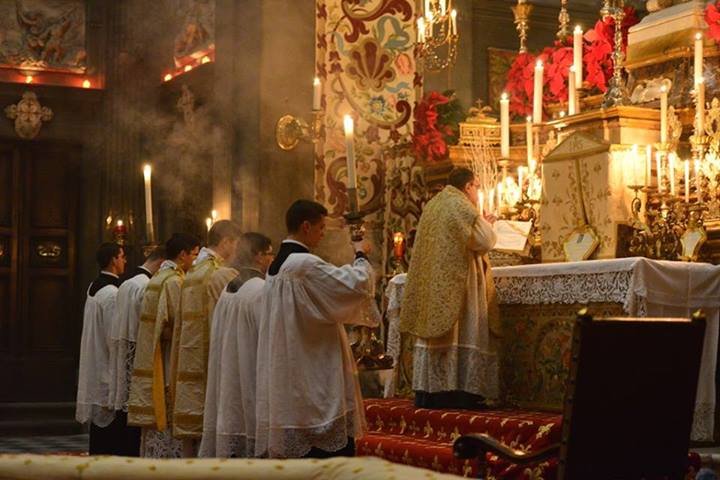 The use of incense within the Mass communicates to our olfactory receptors that we have entered into the sacred as this is not a scent identified with the hum drum of daily life. We find incense referenced all the way back in sacred scripture by St. John in the Apocalypse as he describes his vision of the heavenly worship, where an Angel holds a golden censer near the altar, upon which stands the lamb. The Church incorporates the use of incense during the Mass to symbolize the smoke of purification and sanctification. Incense is also understood to represent the prayers of the faithful rising to heaven.
TOUCH
Our sense of touch is most fully realized through the frequent posture of kneeling within the ancient rite. Simply put, we kneel more at the old Mass. During a Low Mass the faithful kneel from the prayers at the foot of the altar in the beginning all the way until the reading of the Gospel. During the Creed we also kneel when professing that Christ was incarnated and born of the Virgin Mary. Most notably, the faithful kneel to receive Holy Communion.
TASTE
The final of the five senses is taste. The reception of Holy Communion, kneeling and on the tongue, fosters a true sense of awareness in the faithful. We are more clearly able to perceive what it is (or more accurately Who it is) we cannot touch. In the Traditional Mass only the consecrated hands of the priest touches Holy Communion. This was the universal practice of the Church for over a thousand years and, now more than ever, speaks to the sacredness of the moment. The children of Holy Mother Church are spiritually nourished by the Bread of Life.
CONCLUDING THOUGHT
This most sublime moment of Holy Communion concludes our walk through the Mass of all senses. Understanding and appreciating that we are indeed both body and spirit, the Traditional Mass engages each of our five senses, thereby drawing us even deeper into the Eucharistic mystery. In the field of education many readily accept that people learn through a variety of senses: some are more visual, some auditory, others more tactile. Stepping outside of the more contentious liturgical skirmishes of recent decades, let us extend that same understanding of communication to the Sacred Liturgy. It is my hope that more faithful Catholics would seek out and avail themselves to the traditional Mass. May the Mass of the Saints lift our spirits toward heaven through the engagement of our senses.

